
CQC’s proposed hospital inspections: simpler ratings, bigger blind spots?
Opinion | COMI Health UK | 28 October 2026
The Care Quality Commission wants a more streamlined way to assess acute hospitals. But if fewer ratings come at the expense of specialist scrutiny, will the public really have a clearer picture of care quality?
A patient does not experience a hospital as a collection of regulatory categories. They experience a journey: an emergency assessment, a scan, a specialist opinion, a procedure, time on a ward and, eventually, a transfer home or into further care. The quality of that experience depends on each service — and on what happens between them.
That is why the Care Quality Commission’s (CQC) latest thinking on how it should inspect acute hospitals deserves close attention.
At a Hospitals, Secondary and Specialist Care roundtable on 22 October 2026, CQC outlined a proposal to reduce the number of separately rated core services, assess relevant clinical settings within those broader services, and undertake deeper examinations of selected conditions or specialties — described as “litmus tests”. It hopes this will make inspection more proportionate, better aligned with patient pathways and easier to keep up to date.
The objectives are understandable. CQC needs to address outdated ratings, rebuild confidence in its assessments and make better use of clinical evidence. Its return to sector-specific frameworks, key lines of enquiry and clearer ratings characteristics is also a welcome shift away from some of the limitations of the Single Assessment Framework.
But the proposed acute hospital model raises a fundamental question: are we making regulation more effective, or simply making complex hospitals easier to categorise?
Illustrative image: Hospital quality depends on both individual clinical services and the connections between them.
Fewer core-service ratings do not mean fewer clinical risks
CQC’s illustrative structure groups acute hospital care into five broad core services: urgent and emergency care; medicine; surgery and anaesthetics; maternity and neonatology; and babies, children and young people’s care. Ambulance services are shown separately. Settings such as diagnostic imaging, critical care, theatres and outpatients would contribute evidence to the relevant core services.
This would be a substantial change in what receives a distinct rating. In particular, critical care and outpatients would no longer appear as separately rated core services in the illustration. End-of-life care is not clearly visible as a distinct assessment strand.
That does not mean CQC is proposing to stop inspecting those areas. It does mean CQC must explain how it would preserve a coherent, specialist judgement about their safety, effectiveness and governance.
Take diagnostic imaging. It supports medicine, surgery, maternity and paediatric care, but it is also a clinical service with its own leadership, workforce, equipment, standards and risks. If there is a serious weakness in reporting, escalation or staffing, where would that be assessed as a whole? Would the problem be counted across several broader services, diluted within them, or left without a clear service-level conclusion?
The same question applies to critical care, where specialist staffing, equipment, infection prevention and the management of deteriorating patients demand more than incidental scrutiny within a medical or surgical assessment.
A simpler public-facing set of ratings may be useful. A simpler view of what is happening inside specialist services is not.
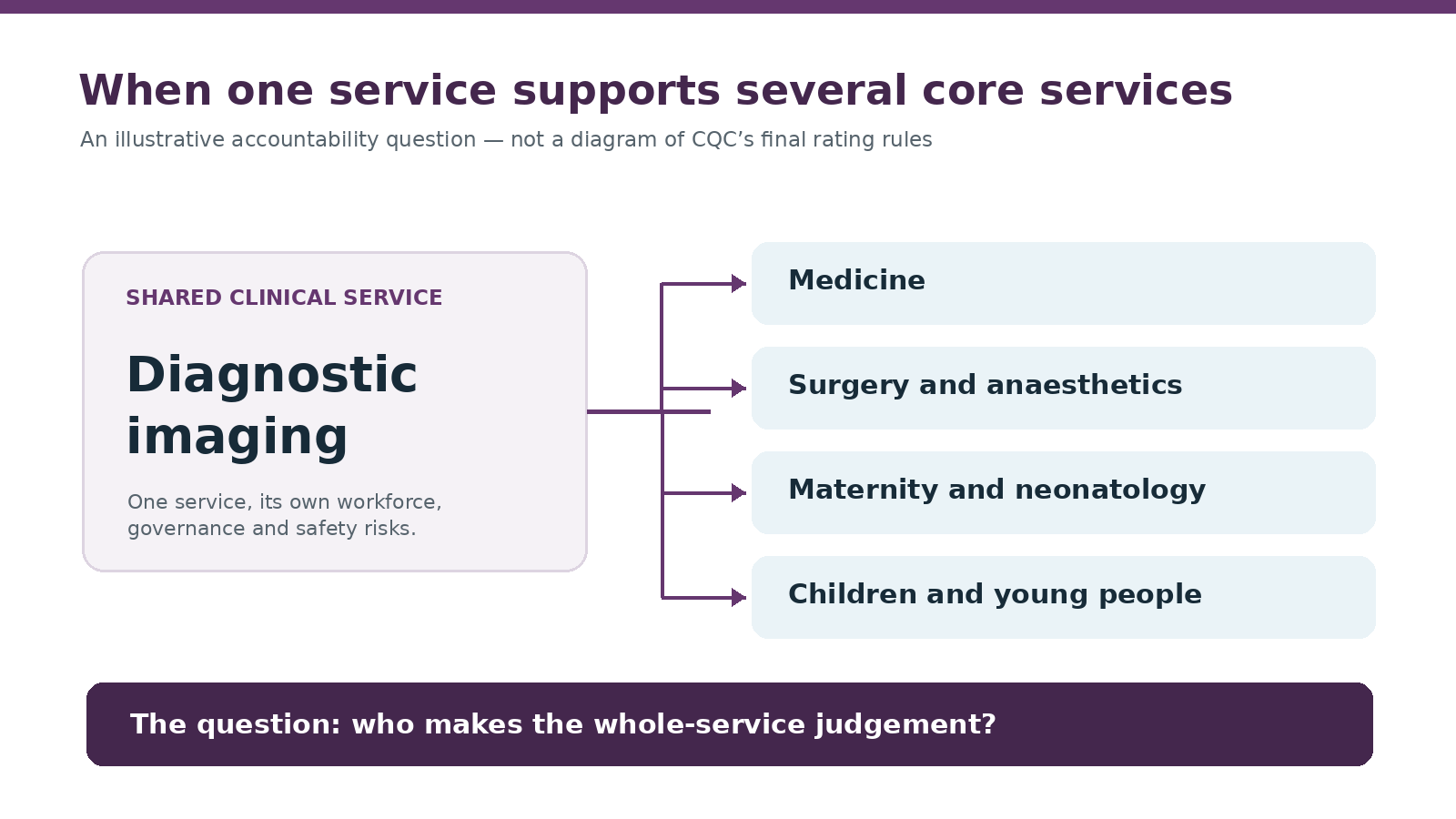
Illustrative interpretation of the accountability challenge raised by CQC’s proposed mapping of shared clinical settings to broader services. This is not CQC’s final ratings methodology.
A “litmus test” cannot represent an entire hospital
The second element of the proposal is more intensive inspection of selected conditions or specialties. CQC offers examples including cancer care, stroke, cardiology and cardiac surgery, orthopaedics, and the treatment of children with appendicitis. The choice would be informed by factors such as service size, risk and intelligence.
Targeted pathway reviews can be extremely revealing. Examining what happens to a patient with a suspected stroke, for example, can expose delays in imaging, gaps in multidisciplinary working, problems with escalation and weaknesses in discharge planning.
The difficulty comes when evidence from selected pathways helps underpin judgements about much broader services.
A hospital may deliver excellent stroke and cancer care while facing serious problems in respiratory medicine, renal services or another specialty that was not selected. Conversely, a weakness in one sampled pathway may not accurately describe the quality of the wider medical service.
There is a basic methodological distinction here: a risk-selected sample is useful for finding problems; it is not necessarily representative evidence from which to generalise about everything else.
CQC’s slides say these assessments would cross-check broader evidence, rather than replace it. That qualification matters. But the slides do not yet set out the sampling rules, minimum coverage or safeguards needed to ensure that unsampled areas are not overlooked.
And the least visible patients may be those most at risk of being missed. Rare conditions, complex disabilities, unusual care pathways and services with weaker patient feedback can be poorly represented by approaches driven mainly by activity volume or existing intelligence. CQC itself reported that only 48% of respondents agreed its draft frameworks would help identify and address inequalities in care.
If the goal is to follow patients, inspect the connections
One of the most persuasive promises in the proposal is better alignment with patient pathways. Yet broad labels such as “medicine” and “surgery” remain organisational categories, not patient journeys.
Consider a patient requiring emergency abdominal surgery. Their care may span emergency medicine, imaging, anaesthesia, theatres, critical care and an inpatient ward. A failure in communication or prioritisation between two apparently well-run departments can be the most consequential failure in that patient’s care.
Who examines the handover? Who tests delays between departments? Who follows decisions that cross hospital sites or management structures?
CQC notes that urgent and emergency care could be inspected alongside medicine or surgery to reflect the full pathway. The key word is could. Where the interface is central to patient safety, connected scrutiny should not be optional.
Organisations rarely fail neatly within the boundaries of their structure charts. Regulation should not assume they do.
Outcomes matter — but numbers cannot carry the judgement alone
CQC also wants greater use of outcome information. That is important, but outcomes must be interpreted with care, especially for tertiary and specialist hospitals.
Clinical results are influenced by case mix, complexity, referral patterns, deprivation and wider system pressures. Some outcomes appear long after the patient has left hospital. Others are shaped by several services and cannot fairly be attributed to one team.
Good data should direct inspectors to the right questions. It should not offer an illusion of objectivity where the underlying comparisons are uncertain.
The proposed method will need to explain how outcomes are risk-adjusted, triangulated with observations and patient experience, and used without penalising services that take on the most complex cases.
The better answer is three connected levels of assurance
We would favour a model that distinguishes three questions rather than expecting one broad rating structure to answer them all.
First, how well is the trust or hospital governed? This requires scrutiny of leadership, workforce, estates, organisational risk, resources and decisions made across sites.
Second, how well do its clinical services operate? This requires proportionate but identifiable specialist assessment of high-risk settings and functions, including the services whose standards may be obscured by broad categories.
Third, what actually happens to patients as they move through care? This requires selected pathway reviews, including the transitions, delays and decisions that cross departmental boundaries.
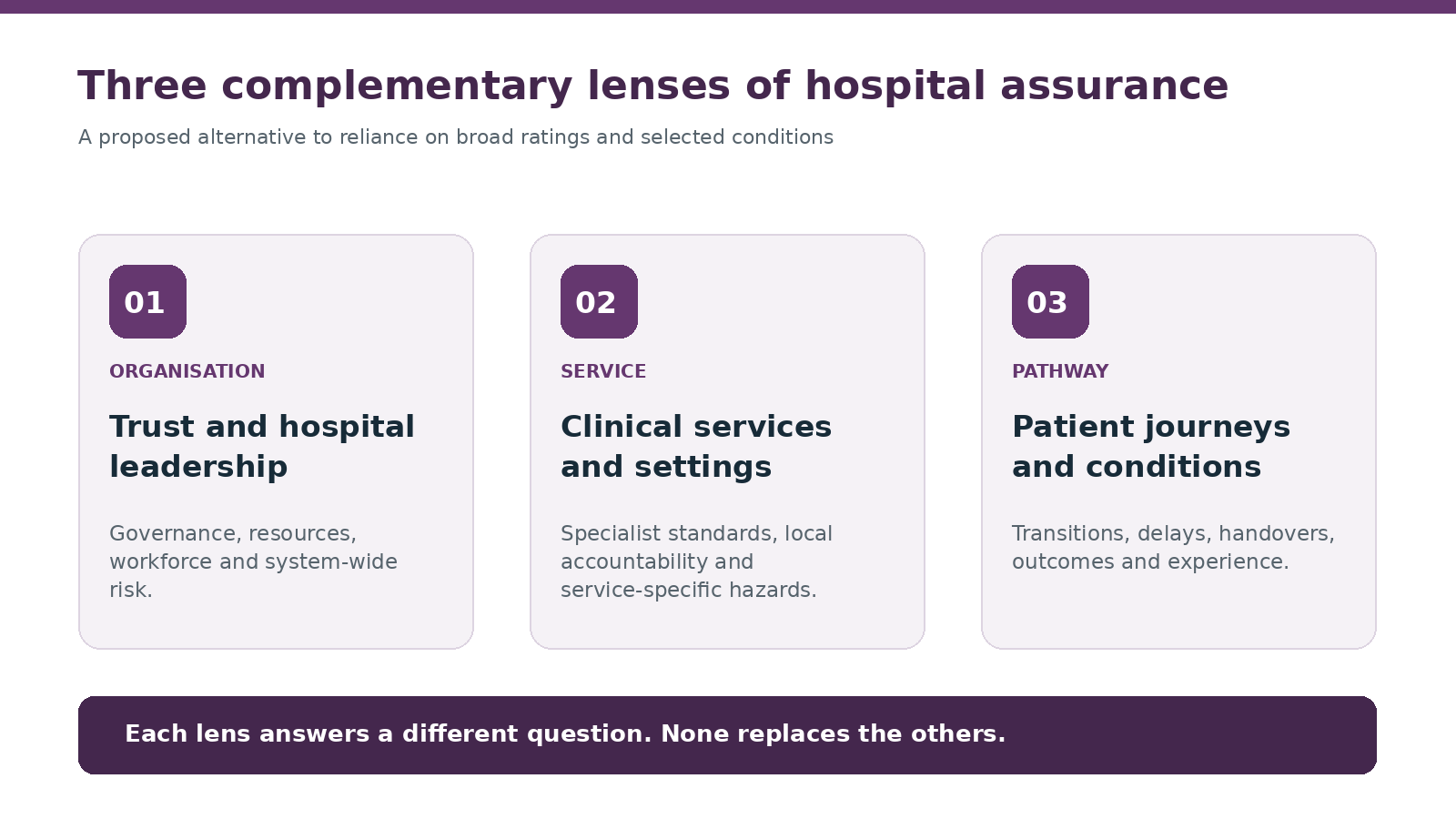
COMI Health’s proposed three-lens approach: organisational oversight, specialist service assurance and patient-pathway scrutiny.
The three levels should inform one another. But none can reliably substitute for another. A strong pathway does not prove that every specialty is safe; a well-led department does not guarantee an effective patient journey; and a positive trust-level governance assessment does not eliminate the need to see care being delivered.
CQC could still make its published ratings simpler. What matters is retaining enough evidence and clarity underneath those ratings for them to be defensible.
The test should be what inspectors might miss
CQC is right to pursue more timely scrutiny. Its latest engagement material indicates that the new frameworks are still being refined and piloted, with an indicative launch in the final quarter of the 2026/27 financial year.
Before adopting the proposed service structure, we think CQC should be able to demonstrate not only that inspections can be completed more efficiently, but that the new method can reliably identify serious weaknesses in shared and specialist services, recognise failures between departments, and explain how individual findings contribute to wider ratings.
The most important question for a pilot is not simply how quickly an inspection produces a rating. It is what the inspection might have missed — and whether that omission could matter to a patient.
A hospital is too complex to be understood entirely through five broad categories and a handful of selected conditions. CQC should simplify how it communicates its findings without simplifying away the risks that regulation exists to uncover.
The public needs more than up-to-date ratings. It needs ratings worth trusting.
This is an opinion piece by COMI Health UK, drawing on experience in healthcare regulation, clinical governance and quality assurance. It reflects draft proposals presented by CQC on 22 October 2026, not a final adopted inspection methodology.
Sources and further reading
- CQC, Hospitals, Secondary and Specialist Care roundtable, 22 October 2026 (presentation provided to participants; particularly slides 16–21).
- CQC, Give your views on draft sector-specific assessment frameworks.
- CQC, Piloting, testing and evaluation of new assessment method.
- CQC, Rebuilding our regulatory approach and digital services.